The desire to fulfill the commandment of the korban Pesach (Passover lamb offering), which I strongly share, is both understandable and noble. In a generation that yearns for the renewal of Temple service, the impulse to ascend the Temple Mount with a lamb and knife, even with governmental permission, reflects a deep longing to obey the Torah’s command. Yet noble intention alone does not validate a mitzvah. The Torah and the Oral Law impose precise, non-negotiable conditions for the offering of the Passover lamb. When these conditions are not met, the act fails to fulfill the positive commandment and risks violating several prohibitions.
A careful examination of the relevant sources reveals that any slaughter performed on the current platform of the Temple Mount falls short in multiple critical respects. The fundamental requirements of location, altar construction, elevation, and ritual integrity cannot be satisfied without first excavating to the original bedrock level of the Azarah (the inner sanctified Temple courtyard). Until that foundational work is undertaken, no surface-level offering can be considered valid.
The Immutable Location and the Altar of Earth
The Torah commands that the Passover sacrifice be brought only at the place that God shall choose (Deuteronomy 16:5-6). The Rambam codifies that the precise location of the altar in the Azarah is fixed and immutable (Hilchot Beit HaBechirah 2:1-4). This location is not approximate. It must correspond to the historical site where the altar stood during the First and Second Temples.
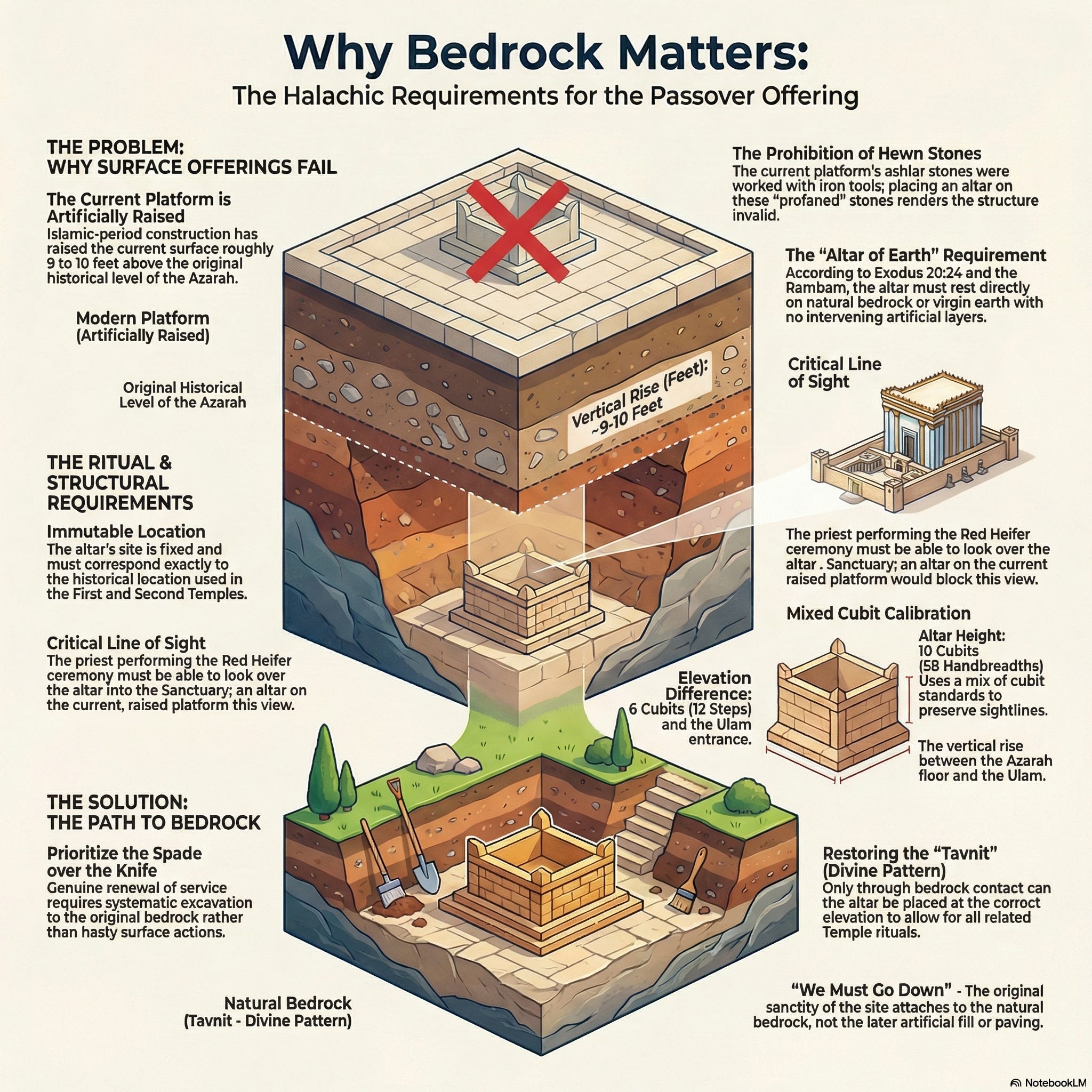
Central to this requirement is the nature of the altar itself. Exodus 20:24 states, “An altar of earth you shall make for Me.” The Oral Law interprets this verse to mean that the altar must rest directly upon natural bedrock or virgin earth, without any intervening artificial platform, fill, arches, or detached layer (Rambam, Hilchot Beit HaBechirah 1:13). The current Temple Mount platform consists largely of ashlar stones and paving laid over fill and leveled surfaces. These are cut and dressed stones, many worked with iron tools. Placing an altar upon them, or slaughtering directly on them, violates the fundamental requirement of direct contact with the earth.
Furthermore, Exodus 20:25 prohibits the use of hewn stones for the altar: “You shall not build it of hewn stones; for if you lift up your iron tool upon it, you have profaned it.” Even if a new altar of whole stones were constructed atop the existing paving, the base itself would remain cut stone, rendering the entire structure invalid according to the plain sense of the prohibition and the Rambam’s ruling.
The Question of Elevation and the Original Azarah Level
The topography of the Temple Mount adds another layer of complexity. In the Second Temple period, the Azarah floor, upon which the altar stood, was at a lower elevation than the floor of the Ulam (Porch). Mishnah Middot 3:1 records that twelve steps, each half a cubit high, separated the Azarah level from the Ulam entrance, creating a vertical rise of approximately six cubits (roughly nine to ten feet). The altar rested on the natural bedrock of the Azarah at this lower level, while the Holy of Holies and Ulam sat upon the higher bedrock foundation of Mount Moriah.
Today’s platform has been artificially raised and leveled through post-Second Temple developments, particularly Islamic-period construction beginning in the seventh century. The visible surface sits significantly higher than the original Azarah bedrock in the area where the altar must stand. Any altar or slaughter performed on the current level would therefore be at the wrong elevation. This misalignment affects not only the physical placement but also the relative heights required for the Temple’s ritual functions.
The Altar’s Calibrated Height and Mixed Cubits
The height of the altar itself is specified as ten amot (cubits), yet this measurement is not simple (Rambam, Hilchot Beit HaBechirah 2:5-6). The total height equals exactly fifty-eight handbreadths. This is achieved through a precise mixture of cubit standards: certain sections employ a five-tefach (handbreadth) cubit, while others use the standard six-tefach cubit. The four horns rise five tefachim above the hearth using the shorter cubit.
This calibration was deliberate. It ensured that the altar did not rise disproportionately high relative to the Ulam and Sanctuary. More importantly, it preserved proper lines of sight for other essential rituals, particularly the burning of the red heifer. Bringing a ten-cubit-high altar onto the current raised platform would place the altar approximately six cubits too high. There would be no way to perform the parah adumah (red heifer ceremony) with that obstruction in the way.
Visibility for the Red Heifer Ceremony
The red heifer (parah adumah) was burned on the Mount of Olives. The priest stood at a designated spot and directed his gaze westward through the Nikanor Gate, over the altar, and into the entrance of the Ulam and Sanctuary (Mishnah Parah 3:6-9; Rambam, Hilchot Parah Adumah 3:2-4). The eastern wall of the Azarah was high, but the line of sight passed through the open Nikanor Gate above the altar level.
If a permanent altar were constructed at the wrong elevation on the current platform, the misalignment would further compromise this critical ritual, which is itself a prerequisite for full purification from tumat met (ritual impurity from contact with the dead). This creates a circular problem: without proper purification, many aspects of Temple service remain restricted; yet building the altar at the incorrect height risks invalidating the very ceremony needed for purification. It is noted that the red heifer can be slaughtered prior to or after the Altar service is initiated, however, line of sight is critical.
Additional Halachic Deficiencies
Beyond the altar and elevation issues, several other requirements remain unmet. Widespread tumat met (ritual impurity from contact with the dead) persists due to the absence of the ashes of the red heifer. Mishnah Pesachim 7:6 states: “If the congregation or a majority thereof was unclean, or if the priests were unclean and the congregation clean, they perform the ritual of the Paschal lamb in uncleanness.” While the principle of tumah hutrah be’tzibbur (impurity is permitted for the public when the majority is impure) allows the offering and consumption when the majority is impure with corpse impurity (Rambam, Hilchot Korban Pesach 7:1-8), the kohanim (priests) must still perform the blood service. A spontaneous slaughter by laypeople bypasses the required priestly role in the blood ritual. It is also noted that only corpse impurity is covered here, not other forms of impurity.
Proper registration in chaburot (registered groups), exact timing of slaughter on the fourteenth of Nisan, and consumption by the registered group that night within the appropriate boundaries are all essential elements that a spontaneous or surface-level act cannot satisfy.
Even those authorities who maintain that offerings may theoretically be brought on the Temple Mount in the absence of a rebuilt Temple building require a kosher altar at the precise historical location. A surface slaughter on ashlar paving meets none of these criteria.
The Necessity of Excavation
The original sanctity imparted by Solomon’s Temple attaches primarily to the natural bedrock and the divinely chosen location rather than to later artificial fill or paving. The current platform, while retaining overall holiness, does not transform cut stones and fill into a valid base for the mizbeach (altar). Only by carefully excavating to the authentic Azarah bedrock level can the correct elevation be restored, the altar be placed in direct contact with the earth, and the proper relative heights be reestablished for all related rituals.
This is not a call for hasty or symbolic action. A quick slaughter, even with governmental blessing, would fail on multiple levels: wrong base material, incorrect elevation, lack of a valid altar structure, and misalignment with essential ceremonies such as the red heifer. Such an act would not fulfill the mitzvah of korban Pesach and could instead constitute an invalid offering or worse.
The path forward requires patience, precision, and reverence for the tavnit (divine pattern) given to Moshe. We must go down. Only through systematic excavation to the original bedrock of the Azarah, followed by the construction of a properly proportioned altar according to all specifications, can the conditions for a valid korban Pesach be met. Anything less falls short of the Torah’s exacting standards.
The Sanhedrin and all who labor for the renewal of Temple service are urged to prioritize this foundational work. Let the discussion begin not with the knife, but with the spade. Only when we have returned to the bedrock can we truly ascend in service to God.
Next Year In Jerusalem!