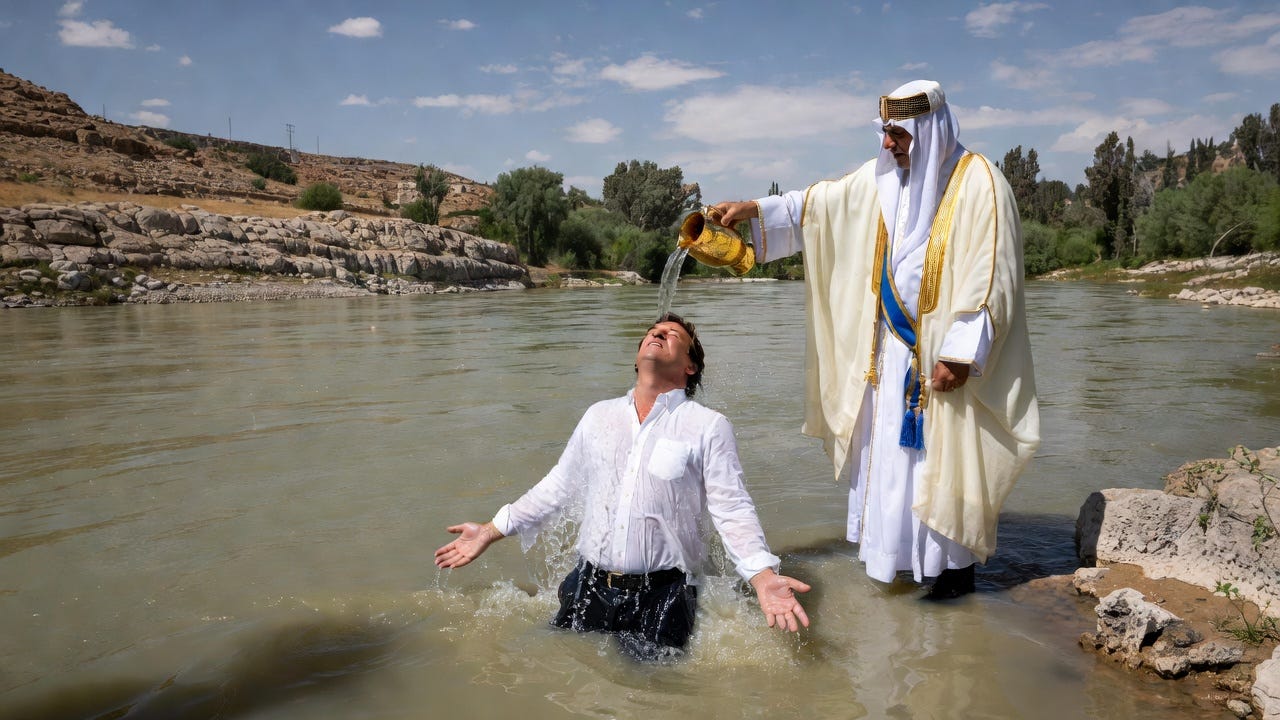
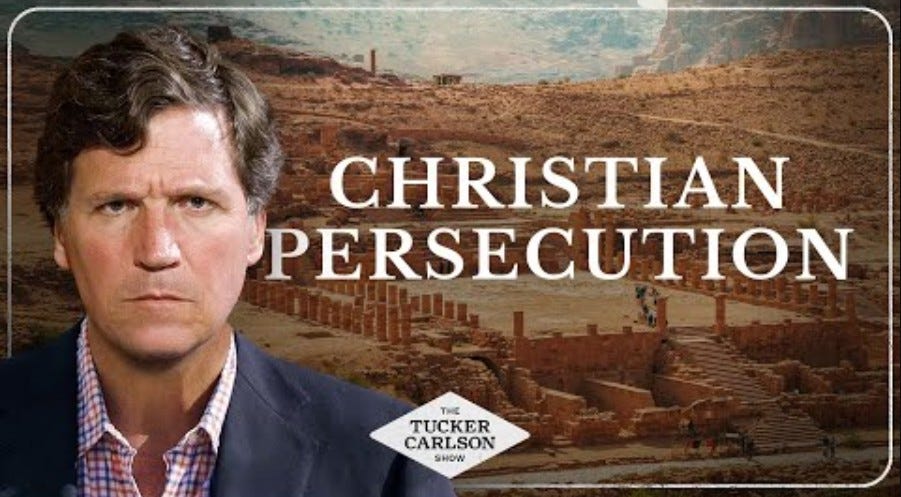
Tucker Carlson’s interview, filmed near the Jordan River baptism site, claims to reveal hard truths about Christians in the Holy Land. In reality, it reveals something else: a directed narrative that gently nudges American Christians away from Israel and toward admiration for Jordan’s Muslim monarchy. Tucker presses his guests, the Anglican Archbishop of Jerusalem and a prominent Jordanian Christian businessman, with leading questions designed to elicit stronger criticism of Israel and Jewish behavior than either man seems eager to deliver.
Guests’ Measured Responses vs. Tucker’s Steering
He repeatedly asks them to confirm that the real problem is Jewish extremism, Israeli restrictions, and American Christian complicity in funding it all. The guests respond with nuance. The Archbishop notes the decline in Christian numbers since 1948 and 1967 but attributes it to war, occupation, economic pressures, and emigration, not solely malice. He insists that extremism exists on every side and that Christians often experience respect and freedom of movement inside Israel. The businessman praises Jordan’s constitutional equality, stability, and Hashemite leadership without ever portraying Jews or Israel as the primary threat to Christians.
Amplifying Fringe Acts, Ignoring Mainstream Condemnation
Tucker, however, keeps steering. He amplifies incidents of spitting by ultra-Orthodox or settler radicals in Jerusalem’s Old City. The Archbishop carefully explains that the act is usually directed in front of or toward clergy, not landing on them, and stems from fringe groups whose behavior is condemned by mainstream Israeli society. In fact, the majority of Jews in Israel and the diaspora are appalled by such conduct. Israeli media, the Chief Rabbinate, and political leaders across the spectrum have repeatedly denounced it. Arrests have been made, and Israeli television has aired undercover reports exposing the behavior precisely to shame the perpetrators. Tucker glosses over that consensus condemnation in order to paint a broader picture of systemic Jewish hostility.
Theatrical Shock: “Really?” More Than a Dozen Times
He also expresses repeated shock, literally saying “Really?” more than a dozen times throughout the interview, whenever the guests mention population declines, minimal Western Christian aid to Nazareth or Bethlehem, or the fact that Jordan’s Muslim king personally funds restorations at Christian holy sites. That rhetorical “Really?” is not neutral surprise; it is theatrical emphasis, calculated to make the audience feel the same outrage Tucker wants them to feel.
Political Motives Behind Hashemite Funding
The king’s funding is presented as a beautiful interfaith gesture. Tucker asks, “Why would that be a Muslim king’s responsibility?” and lingers on the apparent irony. Yet the reasons are obvious and political, not theological. Hashemite custodianship over Jerusalem’s holy places, including Christian sites, is a long-standing claim to legitimacy that gives Jordan influence over the Temple Mount/Al-Aqsa complex and a seat at the table in any future status negotiations. It is statecraft, not sudden affection for Christianity. What Tucker never mentions is that these same Christian sites, the Church of the Holy Sepulchre and the Church of the Nativity in particular, are theological affronts to Judaism. They enshrine beliefs, doctrines of incarnation, resurrection, and divinity that Judaism has always regarded as avodah zarah, foreign worship. No amount of restoration funding changes that fundamental incompatibility.
Frustration with American Christian Support for Israel
Tucker’s deeper frustration seems to be that American Christians, many of them evangelicals, continue to support Israel financially and politically. He frames this support as evidence that they have abandoned their suffering brethren in Nazareth and Bethlehem in favor of a “Zionist agenda.” The guests do not echo that accusation. The Archbishop says explicitly that he is not judging Christian Zionists for their beliefs; he simply asks that those beliefs not exclude or harm local Christians. Tucker pushes past that restraint, suggesting that backing Israel is somehow anti-Christian.
Torah’s Vision of True Peace
From a Torah perspective, this entire framing misunderstands what genuine peace with the nations actually requires. Tucker’s implied vision of harmony sounds appealing on the surface: people eating together, living together, loving together, and even marrying together under a tolerant Muslim monarchy. Judaism has never accepted that model as true peace. Hashem has zero tolerance for idolatry in any form, including the forms that appear in Christianity, in certain expressions of Islam, and, yes, even in Jewish history itself (the golden calf is the eternal reminder). Peace, in the Torah sense, is not achieved by ignoring those differences or pretending they do not exist.
Invitation to Ethical Monotheism
Instead, the prophetic vision is of Israel restored as a holy people and a light to the nations. Gentiles are not asked to convert to Judaism, but they are invited, indeed expected, to accept the core ethical and monotheistic commandments that the Torah presents as binding on all humanity: worship of Hashem alone, rejection of idolatry, and a moral order built on justice, honesty, and the sanctity of life. When the nations come to Jerusalem, they come not to celebrate a multicultural festival but to learn Torah and walk in the ways of Hashem (Isaiah 2:2-4, Micah 4:1-3, Zechariah 8:20-23). That is the open door Judaism has always extended: an invitation to ethical monotheism without erasing the unique covenantal role of the Jewish people.
Hope for Receptive Christian Zionists
Interestingly, many Christian Zionists, especially those in the Hebrew Roots movement, are already drawn toward this biblical vision. As they study the Hebrew Scriptures and encounter the concept of avodah zarah in its original context, they often shed elements of traditional Christian theology that conflict with strict monotheism. They are not always aware of the precise meaning of the term avodah zarah—foreign or strange worship—but once they grasp it, the shift comes relatively easily for those sincerely seeking biblical fidelity. Those more deeply invested in classical Christian doctrines, particularly replacement theology or forms of idolatry that persist unexamined, are far less likely to embrace this path.
Tucker’s Wedge-Driving Undermines Alignment
Tucker’s narrative quietly undermines that potential alignment. By elevating Jordan’s model and questioning Christian support for Israel, he drives a wedge between American Christians and the biblical promise that those who bless Israel will be blessed. He celebrates a status quo in which Christian holy sites remain under custodianship arrangements that serve Arab political interests, while downplaying the prophetic restoration of Jewish sovereignty in the very land where those prophecies were spoken.
Guests’ Restraint Reveals the Technique
The two Christian guests, to their credit, refused to be fully steered into the harsher indictment Tucker seemed to want. They spoke of coexistence, of the need for reconciliation, of teaching tolerance to all sides. That restraint is the most revealing part of the interview. Even while acknowledging real hardships, they would not reduce the complex realities of the Holy Land to a simple morality tale in which Jews are the villains and a Muslim king is the hero.
Aligning with the Prophetic Trajectory
American Christians who stand with Israel are not betraying their faith. They are aligning themselves with the trajectory the Torah and the Prophets have always described: the ingathering of the exiles, the rebuilding of Zion, and the eventual turning of the nations toward the God of Israel. Tucker may find that scenario distasteful. He may prefer the comfort of Jordanian stability and the optics of a Muslim monarch restoring a Christian tomb. But the Torah offers a different and far more demanding picture of peace: not superficial harmony that accommodates avodah zarah, but truth-centered redemption in which Israel teaches the world to know Hashem.
That is the light to the nations. That is the vision worth supporting.
Tucker’s full interview - With the above in mind…you can’t unsee it.