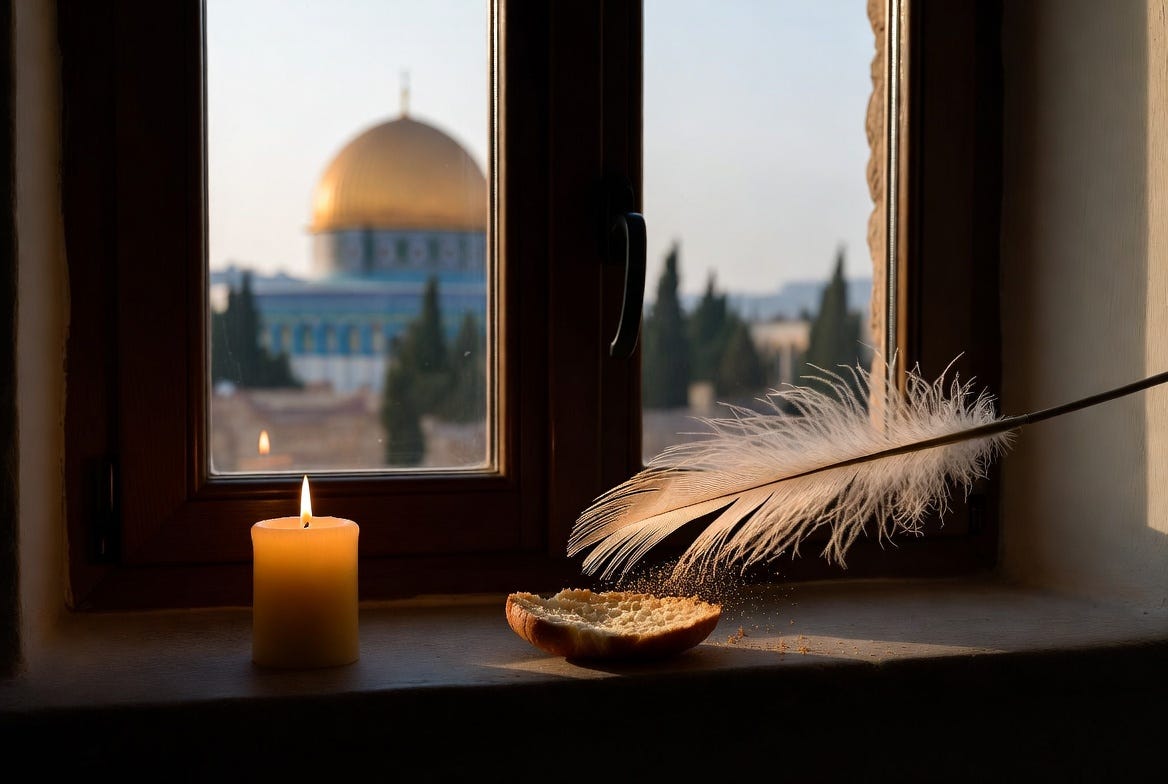
In February 2026 hundreds of Haredi men in Bnei Brak chased two female IDF soldiers through the streets, overturned a police car, set a police motorcycle on fire, and torched trash bins while blocking major roads. Similar riots erupted on Highway 4 near Bnei Brak where Peleg Yerushalmi protesters lay on the pavement, halted traffic for hours, and clashed with officers. In Jerusalem neighborhoods demonstrators blocked intersections, burned garbage, and disrupted daily life whenever yeshiva students faced draft enforcement. The outrage filled the streets with smoke and overturned vehicles. Now Passover 2026 begins April 1 and the same streets sit quiet. Religious communities search their homes with a feather and candle for every trace of chametz (leaven) yet leave the Temple Mount untouched and the single national korban Pesach (Passover offering) unoffered.
The Bible commands this offering at the precise place Hashem chose. “You may not sacrifice the Passover offering within any of your gates, which the Lord your God gives you; but at the place which the Lord your God shall choose to cause His name to dwell in, there you shall sacrifice the Passover offering at even, at the going down of the sun, at the season that you came forth out of Egypt.” (Deuteronomy 16:5-6)
The Sages teach that this single national korban Pesach stands as a fixed-time public offering brought on behalf of the entire people of Israel. The Mishnah in Pesachim 7:6 states: “If the [entire] congregation, or a majority are impure, or the kohanim are impure and the congregation is pure – it is done in impurity.” Rambam rules in Hilchot Korban Pesach and Hilchot Bi’at HaMikdash that time-sensitive communal offerings may be brought even in a state of ritual impurity when the majority of the community carries tumat met (impurity from contact with the dead). The slaughter, blood presentation on the altar, and the core act of offering proceed. Individual eating of the meat requires separate purity but does not block the offering itself. Chazal apply the same principle to the tamid (daily continual offering) which must occur twice each day even under conditions of communal impurity. The positive command on the Mount overrides the purity objection cited by some leaders.
Draft Law Triggers Fury While the Biblical Command Draws Silence
When the state enforces the draft law the response comes fast and fierce. Peleg Yerushalmi and Jerusalem Faction activists mobilize thousands. They block highways, attack officers, overturn vehicles, and set fires in Bnei Brak and Jerusalem neighborhoods throughout late 2025 and early 2026. They frame military service as a threat to talmud Torah (Torah study) and turn neighborhoods into scenes of burning debris and clashes. The same communities show no parallel action for the korban Pesach. The Sanhedrin committee for the Passover offering has long prepared. Lambs meeting biblical standards stand ready. Kohanim (priests) have trained in the procedures. Halakha states that the altar in the correct azarah (courtyard) spot on the Temple Mount suffices without a completed Temple structure. The site can be readied quickly once access is granted. Palestinian leaders and the PLO have issued repeated warnings of violence if the sacrifice occurs during the festival yet no mass street blockades or vehicle burnings have arisen from the religious public demanding that the command be fulfilled.
This pattern shows where passion flows. The draft touches immediate personal and communal autonomy so streets fill with protesters willing to clash with police. The korban Pesach touches the direct service to Hashem at the appointed time and place so the response stays limited to quiet preparations and symbolic acts. The feather and candle hunt every speck of chametz in kitchens and closets while the greater neglect of the Mount offering passes without comparable disruption. Some Haredi politicians have gone further and pushed measures to restrict Jewish access to the Temple Mount citing purity concerns. That step moves beyond mere refusal to perform the mitzvah. It actively prevents others from obeying a clear positive command.
Purity Claims and PLO Threats
Halakha does not support using ritual impurity as a barrier to the national korban Pesach. The Mishnah and Rambam establish that public time-bound offerings override communal tumah precisely because they serve the entire nation. The tamid offers the clearest parallel. It must be brought morning and evening without delay even when the people as a whole carry tumat met. The single korban Pesach carries identical status. Purity objections cited in public statements do not align with this halakhic framework from the Mishnah in Pesachim and Rambam in Hilchot Korban Pesach. Bowing to PLO threats adds a separate issue. The PLO has warned explicitly against any Passover sacrifice on the Temple Mount and threatened violence if the offering proceeds. Yielding to such threats to avoid conflict means subordinating the biblical command to external pressure. The positive obligation on the Mount stands independent of political warnings.
Other issues expose the same misplaced priorities. Religious factions invest heavy energy in opposing changes to yeshiva funding and draft exemptions. They fight fiercely to maintain the status quo on those matters. They direct comparable effort toward limiting Jewish presence on the Temple Mount itself. Yet the core command to offer the single national korban Pesach at the chosen place draws none of that intensity. The draft law is enforced by the state. The offering command comes directly from the Bible. Halakha places the positive mitzvah of the korban Pesach higher in priority than exemptions from military service that rest on interpretive grounds. The Sages never equated talmud Torah protections with canceling a fixed-time national offering on the Mount.
The Command Remains Unchanged
The Bible ties the offering directly to the Land and the place Hashem chose. Jewish sovereignty over Jerusalem includes the Temple Mount. The single national korban Pesach must occur there at the appointed season. The first Passover in Egypt used blood on doorposts as a unique one-time event. Every Passover since the entry into the Land binds to the central sanctuary site. Chazal ruled in the Mishnah that the korban Pesach follows the rule of fixed-time offerings that override impurity for the community. The plain Hebrew reading of Deuteronomy 16 leaves no ambiguity. The mitzvah requires action on the Mount.
Religious communities accept the current reality and focus energy on protecting yeshiva study schedules. The bedikat chametz proceeds with full vigor in every home. Families then gather for the Seder with the zeroa (shankbone) on the plate as a symbol and four cups of wine to mark the Exodus. The actual offering commanded in the Bible remains unperformed. The Sanhedrin committee continues its work. Lambs wait. The altar spot stands identified. Political and security concerns block the path while the command stands firm.
The contrast stands unmistakable. When the issue is draft enforcement the streets fill with determined protesters ready to confront police and burn vehicles. When the issue is fulfilling Hashem’s Passover offering at the place He designated the response stays confined to private searches for chametz and quiet study. The single national korban Pesach carries the weight of a direct positive command tied to the central site of Jewish worship. Everything else ranks behind it. The silence where fury should rise for the offering exposes the true order of priorities in practice. The korban Pesach belongs on the altar on the Mount at the appointed time. The biblical command has not changed. The question remains why the passion reserved for the draft never appears for the service Hashem ordered in the place He chose.